
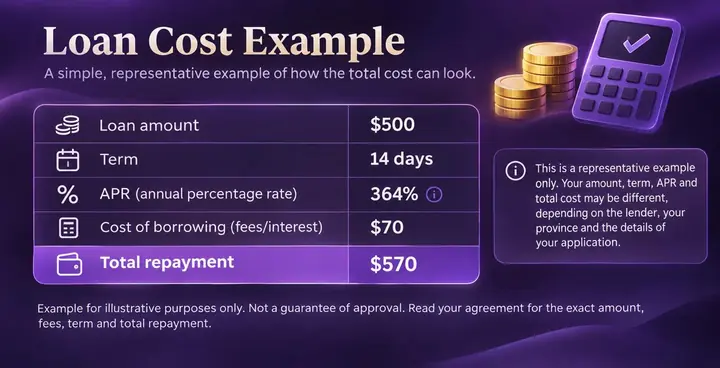
Why ‘guaranteed approval’ is a marketing red flag
Think about what a lender is doing. It’s handing you money and hoping to see it again. So it looks at you first: your income, your bank account, what you already owe. That’s the job. An ad that says yes before any of that has happened is just an ad.
Lots of people type “guarantee loan” into Google at 11 p.m. when the account is nearly empty. Fair enough. But the word is the trap. A promise made up front can’t be based on a review, and the review is the only thing that tells a lender whether you can afford the payments. Sometimes it says no.
When a site shouts about guaranteed approval loans, it usually means one of these:
- Most applicants get approved, not all of them.
- You’ve been pre-qualified, which can flip after a closer look.
- The site is a matching service that passes your details to lenders. That’s fine in itself, but then the guarantee isn’t the site’s to give, because only the lender decides.
None of these is a guarantee. The first is a statistic, not a promise, and the third only moves the decision to someone else.
Better ads talk about odds. “We work with people who have thin credit files” says how a lender thinks. It doesn’t tell you how your application will end.
Here’s a quick test. Read the ad and ask what it would say if you applied with no income at all. A real lender’s answer is obvious: it would decline. If the ad claims it would still say yes, it isn’t describing a loan.
One more thing, because it confuses people. Skipping a credit bureau report isn’t the same as skipping the review. More on that next.
What legitimate lenders actually check
“No credit check” usually means the lender won’t pull your file from Equifax or TransUnion. That’s all it means. Somebody still looks at you: who you are, whether you’re old enough to borrow where you live, and whether the money can plausibly come back.
| Factor | Why the lender checks it | What you may be asked for |
|---|---|---|
| Identity | Fraud prevention, legal duties | Government photo ID |
| Age and residency | Legal age in your province, living in Canada | Date of birth, Canadian address |
| Income | Shows where repayment comes from | Pay stubs, benefit letters, bank statements |
| Bank account | Money goes in and comes out of it | Void cheque or secure bank verification |
| Existing payments | They shrink what you can afford | List of current loans, rent, bills |
| Contact details | To verify you and reach you | Phone number, email |
Statements get the longest look. Deposits show how regular your pay is. Overdraft fees show how tight things run. Payments to other lenders show what’s already spoken for. Plenty of lenders skip the PDFs and use a secure bank-connection tool. It’s quicker for you, but they see the same data.
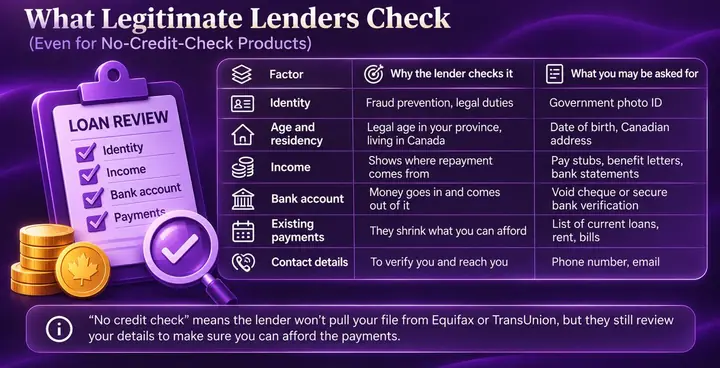
Picture someone with steady pay, most of it already gone to rent, a car loan and two other payments. One more payment might be too much. The lender can see that without any credit report, so it says no, or offers less. That’s normal, and it’s exactly why a yes can’t be promised before anyone has looked.
A decline isn’t a judgment on you, by the way. Usually it just means this amount, this month and this lender don’t fit. Ask for less, or for a different term, and the answer can change.
Lenders also run small checks you might never notice: a call or text to confirm your number, a match between the name on your ID and the name on the account, a look at whether the address fits. Each takes seconds, and each can stop an application that doesn’t line up.
How to spot an unreliable lender
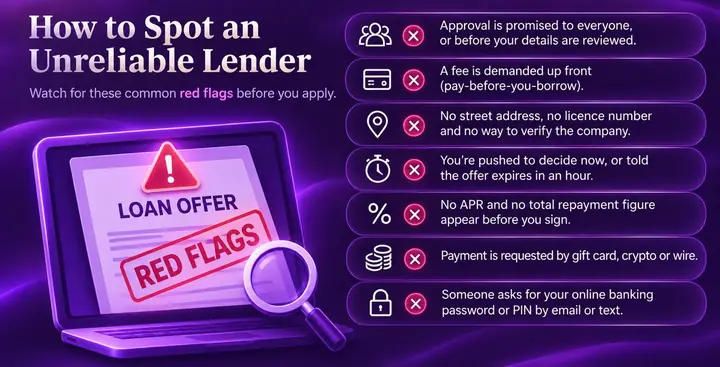
Most warning signs show up early, before you’ve given anything away.
- Approval is promised to everyone, or before the lender has seen a single detail.
- A fee is demanded up front. Pay-before-you-borrow is a classic fraud pattern.
- There’s no street address, no licence number and no way to look the company up with your provincial regulator.
- You’re pushed to decide now, or told the offer expires in an hour.
- No APR and no total repayment figure appear before you sign.
- Payment is requested by gift card, crypto or wire.
- Someone asks for your online banking password or PIN by email or text.
Sites that sell a guarantee loan like it’s a gadget, instead of explaining how they decide, tell you almost nothing about how they’ll behave after you sign. Plain terms, a named lender and time to read the contract beat a confident headline every time.
Checking a licence takes a few minutes. Get the lender’s name and licence number from its site, then search your province’s register. Ontario has a government business licence search, and in BC it’s Consumer Protection BC. Can’t find it? Or does the contract name a company the website never mentioned? Stop and ask why.
Look-alike sites are another trap. Scammers copy the name and logo of real lenders, so read the web address letter by letter. If you reached a page through an ad, type the lender’s address in yourself instead of clicking.
Eligibility conditions at nocreditcheckloanscanada.ca
Lenders set the rules, and they shift by province and by product. The usual basics:
- Age of majority where you live (18 or 19)
- Canadian residency and a Canadian address
- Regular income from a job, benefits or a pension
- An active chequing account in your own name
- Valid government ID, a working phone and an email address
- Loan amounts from $100 to $50,000: payday loans up to $1,500, installment loans from $250 to $50,000
- Each lender sets its own minimum income
- Partner lenders operate in all provinces
Tick every box and approval gets more likely. Likely, not certain. No checklist turns an application into one of those guaranteed approval loans you see advertised elsewhere, because the lender still makes the call after reviewing your details, and sometimes that call is no.
Comparing options? Our no refusal instant loan page covers that kind of product. If you’d rather repay in several scheduled payments, look at installment loans in Canada.
How to apply (step by step)
- Check the basics above, then decide how much you really need. Asking for less than you could get is usually the smarter move.
- Fill in the online form on nocreditcheckloanscanada.ca. Use your legal name and the address on your ID, since a mismatch is the quickest way to stall a review.
- Send what the lender asks for: ID, proof of income, maybe a bank connection.
- Read the agreement before you sign. Hunt for the amount, APR, fees, term, payment dates and the total you’ll pay back. If anything is fuzzy, ask.
- Sign only if the payments fit your budget. If you’re approved, the money lands in your account. The application takes under 10 minutes. Decisions can come in minutes during business hours (Mon-Fri, 9 a.m.-5 p.m. ET), and funding often lands the same day, sometimes within an hour with Autodeposit.
Pull together your ID, a recent pay stub or benefit letter and your account details before you open the form. Applications stall when somebody has to go hunting for a document halfway through.
After you submit, keep your phone close. Lenders often call or text to confirm details, and a missed call can slow things down. Check your email too, junk folder included.
And if anyone asks for a fee before the money arrives, stop. Call your provincial regulator before you do anything else.
Regulatory framework in Canada
The short version is in the box above. Consumer lending is mostly a provincial job, so what applies depends on where you live. In Ontario, payday lenders are licensed under the Payday Loans Act, 2008 and overseen by Consumer Protection Ontario. In BC, Consumer Protection BC licenses payday lenders. Rules change, so check current requirements with your regulator.
Ottawa sets a ceiling on interest through the Criminal Code. Since January 1, 2025 that ceiling is 35% APR. Payday loans sit under separate provincial rules: in Ontario, Alberta and British Columbia the fee can’t go above $14 per $100 borrowed.
Disclosure counts as much as the caps. Before you sign, a regulated lender has to show you what the loan costs. In Ontario a payday lender must put the amount, the length of the loan and the cost on page one of the contract, and you get two business days to cancel without penalty or giving a reason. If a lender won’t write the numbers down, it isn’t playing by the rules.
Not sure which rules cover your loan? The regulator’s website usually has a plain-language page, and a short call costs nothing.
Borrowing responsibly
Do the maths before you borrow. A $300 payday loan for two weeks, at the cap of $14 per $100, costs $42, so you pay back $342. Doesn’t sound like much until you turn it into an annual rate, which is huge. That’s why this kind of loan fits a one-off emergency and doesn’t fit a monthly shortfall.
Write a mini budget before you apply: pay coming in, fixed bills going out, what’s left. If the loan payment is bigger than what’s left, don’t ask for that amount. Ask for less, or look at another route.
A few questions to put to yourself. Can the repayment come out of your next paycheque and still leave something for rent, food and the bus? What if your pay lands three days late? And is there anything cheaper, like a payment plan with the company you owe, an advance from your employer or a credit union loan?
Look up what the agreement says about missed payments, too. Late fees, extra interest, collection steps. Better to read that on page two than to find out the day a payment bounces.
Don’t take a second loan to cover the first. It snowballs fast. If you’re already stretched, a non-profit credit counselling agency will go through your options for free.
Keep a copy of the agreement and your payment dates. If a lender’s contact starts to feel pushy or confusing, jot down what was said and take it to your provincial regulator.
Why choose nocreditcheckloanscanada.ca
We won’t tell you approval is certain, because it never is. What we will do is spell out what’s needed, what a loan costs and what happens if you miss a payment, so you can decide before you apply. Applications are accepted 24/7. There’s no hard pull from Equifax or TransUnion; income is checked through a secure bank connection or an uploaded statement. Loan amounts run from $100 to $50,000.
Approval depends on the lender’s review of your application. If you meet the basics and the terms fit your budget, you can start with a short online form. Apply on nocreditcheckloanscanada.ca and read the terms before you decide.
Frequently Asked Questions
Is ‘no credit check’ the same as ‘guaranteed approval’?
No. “No credit check” only means the lender doesn’t use a credit bureau report. It still looks at your income, identity and bank account, and it can still decline. A guarantee loan claim promises the outcome before any of that, which no licensed lender can truthfully do.
What should I do if a lender promises guaranteed approval?
Stop, and don’t send anything else. Don’t pay a fee up front. Check the lender’s licence with your provincial regulator and compare the written terms with what you were told. If they don’t match, walk away. And if you think guaranteed approval loans are being used to collect fees or personal data, report it to the Canadian Anti-Fraud Centre and your provincial regulator.

Michael Carter focuses on personal finance, alternative lending, and loan options available to Canadians with limited or poor credit histories. His articles explore no credit check loans, online lending services, and short-term financing solutions for consumers who may have difficulty qualifying for traditional bank loans.
He covers topics such as loan eligibility requirements, income verification, application procedures, repayment terms, interest rates, and borrowing costs. Michael also explains the differences between traditional credit checks, alternative approval methods, and bank account verification processes used by some online lenders.
Through his content, Michael helps readers understand how no credit check loans work, what lenders may consider when reviewing applications, and which details to examine before accepting a loan offer. He also discusses alternative financing options and practical ways to manage unexpected expenses.
Michael emphasizes transparency, financial awareness, and responsible borrowing. His goal is to make information about alternative lending easier to understand and help Canadians evaluate their financing options based on their individual financial circumstances.
More from the blog
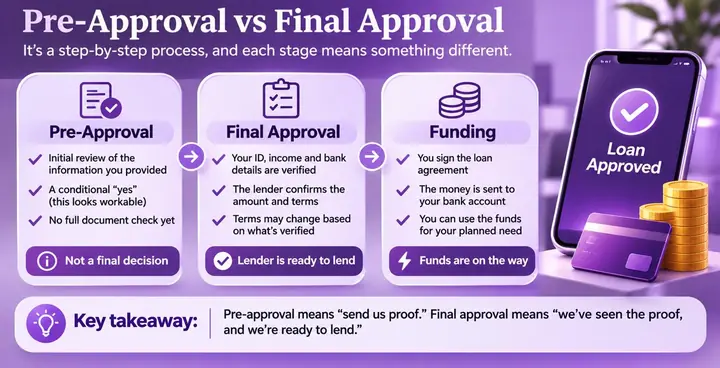
Loan Pre-Approval: What It Really Means (and What It Doesn’t)
Loan pre-approval explained: what it is, what it isn't, and the real steps to funding at nocreditcheckloanscanada.ca.