
What ‘pre-approval’ means for an online loan
Pre-approval is the lender’s first look at your application. You’ve told it the basics: who you are, what you earn, where you bank. It runs that through its rules and comes back with something like “this looks workable.” That’s all. Nobody has seen a pay stub or an ID yet, and that matters more than it sounds.
A lot of people search for “pre approval” hoping to find a promise. What they find is a conditional answer, and the condition is that everything you typed turns out to be true, complete and still accurate when somebody checks it.
Online, this first step is quick because it leans on your form. Some lenders glance at a few data points, some ask you to connect your bank account, and some just apply income rules to what you entered. Lenders in our partner network don’t run a hard Equifax or TransUnion pull; they review 60-90 days of bank deposits through a secure, read-only connection or an uploaded statement.
Don’t mix it up with the mortgage pre-approval you may have heard about from a bank. That one comes with paperwork and often a rate hold. An online loan pre-approval is lighter, and what it commits the lender to is lighter too. Read the wording of the lender’s answer, because it usually says what that answer depends on.
Why do lenders bother with a first step at all? Mostly to save everyone time. If a form shows no income, or an account that can’t receive deposits, there’s no point asking for ten documents. And for you it’s a quick way to find out whether to go on before you dig through a drawer for paperwork.
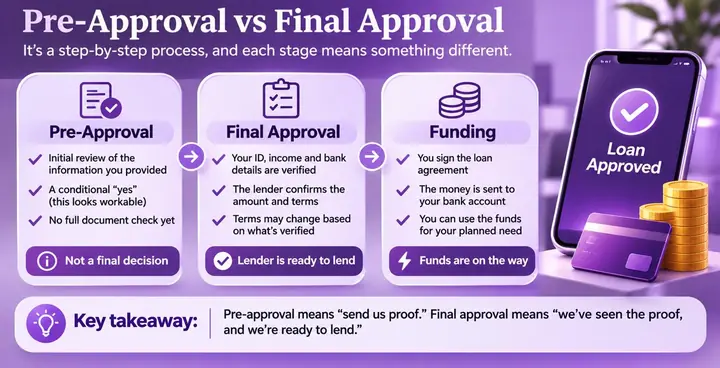
Pre-approval vs final approval: the real difference
Short version. Pre-approval is the lender saying “send us proof.” Final approval is the lender saying “we’ve seen the proof, and we’re ready to lend on these terms.”
| Stage | What the lender has | What it tells you | Can it still change? |
|---|---|---|---|
| Pre-approval | What you typed in, maybe a quick data check | Your application looks workable | Yes |
| Final approval | Verified ID, income and bank account | The lender is ready to lend on stated terms | Only if something doesn’t match or changes |
| Funding | A signed agreement and working bank details | Money is sent to your account | No |
The amount can move too. The figure you see at the start may be higher than what the lender ends up offering once it has read your bank statements. That’s not a trick. It’s just working with better information.
Here’s how it plays out. Sam types $3,200 a month into the form. The pay stub says $2,700, because last month’s overtime was in the first number. The lender isn’t being picky. Its first answer rested on the higher figure, and now it has to redo the sums. Maybe Sam still qualifies, for less. Maybe not.
Other mismatches are smaller: an account in a different name, an address that doesn’t match the ID. A lender that spots them is doing its job, even when it’s annoying.
What happens between pre-approval and funding
Between the first answer and the money there are a few steps. They’re usually short, but any one of them can pause or stop an application.
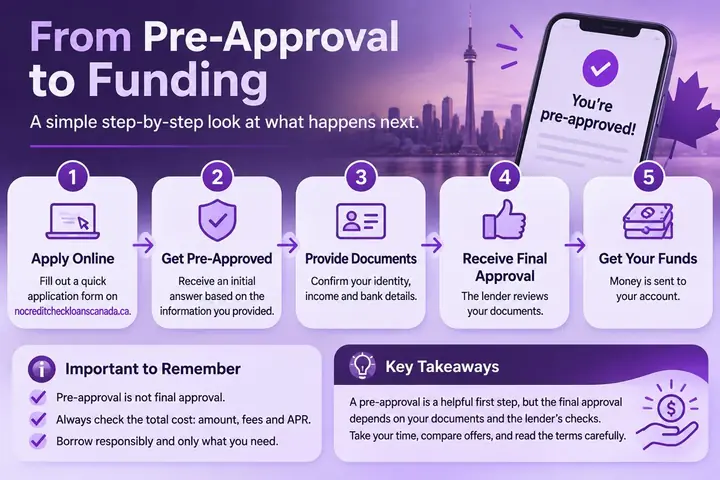
First comes identity. The lender wants to be sure you are who you say you are, normally with a photo of your government ID and a few matching details. Then income and bank account: pay stubs, benefit letters or a bank connection, so the lender can see the income exists and the account is yours and active.
With the proof in hand, the lender makes its final decision. It may confirm the amount and terms, change them or decline. If it goes ahead, you get the loan agreement, usually to sign electronically. Read it before you do. After you sign, the lender sends the money to your account. The application takes under 10 minutes. Decisions can come in minutes during business hours (Mon-Fri, 9 a.m.-5 p.m. ET), and funding often lands the same day, sometimes within an hour with Autodeposit.
The things that most often slow all this down:
- A blurry photo of your ID
- Names or addresses that differ between documents
- Income that has changed since you filled in the form
- A bank account that isn’t in your name
- A missed call or text asking for one more document
None of it is dramatic. These are the ordinary reasons a pre-approved application takes longer, or ends without funding.
Waiting is the awkward part. Don’t commit to anything that depends on the money, like a deposit or a repair you couldn’t otherwise cover, until you’ve seen the final agreement and the funds are actually in your account.
Eligibility conditions
Every lender sets its own rules, and they vary by province and product. Most want to see:
- Age of majority where you live (18 or 19)
- Canadian residency with a Canadian address
- A regular source of income, such as a job, benefits or a pension
- An active chequing account in your name
- Valid government ID, plus a working phone number and email
- Loan amounts from $100 to $50,000: payday loans up to $1,500, installment loans from $250 to $50,000
- Each lender sets its own minimum income
- Partner lenders operate in all provinces
Meeting these gets you through the door. It makes a pre approval more likely, never certain, because the lender still checks everything later.
If you’re comparing products before you apply, our no refusal instant loan page explains that option.
How to apply (step by step)
- Check the basics above and work out how much you actually need. Don’t start from the maximum the form allows.
- Fill in the online form on nocreditcheckloanscanada.ca. Use your legal name, and enter income the way it appears on your pay stub. Small mismatches cause big delays later.
- Read the lender’s first answer slowly. It may be conditional, so check the amount shown and what’s still needed.
- Send the documents the lender asks for, and keep your phone nearby in case it calls or texts.
- Go through the final agreement. Check the amount, APR, fees, term, payment dates and total repayment. Sign only if it fits your budget, and expect the money to arrive after that, not before.
Get your documents together before step two. Things go more smoothly when you aren’t hunting for a pay stub halfway through. And if anyone asks you to pay a fee before the money arrives, stop and contact your provincial regulator.
Common misconceptions about pre-approval
A few ideas come up again and again.
- “Pre-approved means the money is mine.” It doesn’t. It means your application looked workable at the first stage. Funding comes after verification and a signed agreement.
- “The lender has promised me this amount.” Not quite. The amount can change once the lender sees your documents.
- “I don’t need to send anything else.” You almost always do. That’s what the middle steps are for.
- “It was fine yesterday, so it’s fine today.” Check the dates and conditions in the lender’s answer. Things you entered can change, and so can the answer.
- “A big pre-approved number means I should borrow it all.” Borrow what you need. A larger loan means larger payments.
- “Checking is free, so nothing can go wrong.” Ask the lender what it checks at this stage. Some use a credit or data inquiry, and you should know before you click.
The pattern is simple. Pre approval tells you where you stand today. Final approval and funding tell you where you end up.
Regulatory framework in Canada
The disclosure box above has the short version. Consumer lending is mostly a provincial matter, so what applies to you depends on where you live. In Ontario, payday lenders are licensed under the Payday Loans Act, 2008 and overseen by Consumer Protection Ontario. In British Columbia, Consumer Protection BC licenses payday lenders. Rules change, so check current requirements with your regulator.
Federal law sets the outer limit. Since January 1, 2025, the criminal interest rate has been 35% APR. Payday loans follow provincial rules instead, and in Ontario, Alberta and British Columbia the fee can’t exceed $14 per $100 borrowed.
For pre-approval, disclosure is what counts. A regulated lender has to tell you what the loan costs before you sign, and a loan pre-approval answer doesn’t replace that. In Ontario, a payday lender must state the amount, the length of the loan and the cost on the first page of the contract, and you have two business days to cancel without penalty or giving a reason.
Borrowing responsibly
A pre-approved number is a ceiling, not a target. Say you’re pre-approved for $2,000 and you need $700 for a car repair. Borrow $700. The extra $1,300 comes with fees, interest and payments you didn’t plan for.
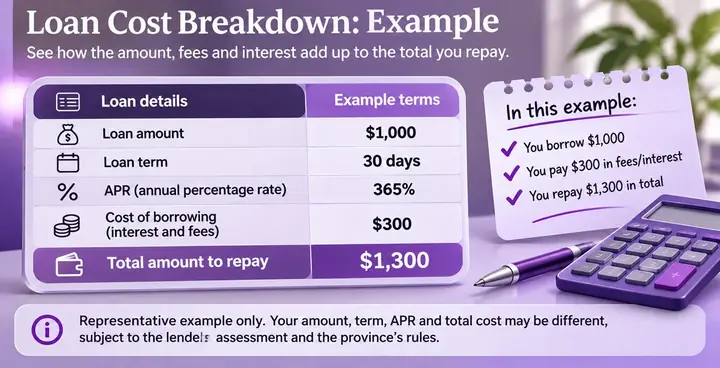
Before you accept final terms, put the payment next to your budget. What comes in, what goes out on fixed bills, what’s left? If the payment takes most of what’s left, ask for a smaller amount or a longer schedule. A loan repaid in several scheduled payments can sit more comfortably in a monthly budget, and our installment loans in Canada page explains how those work.
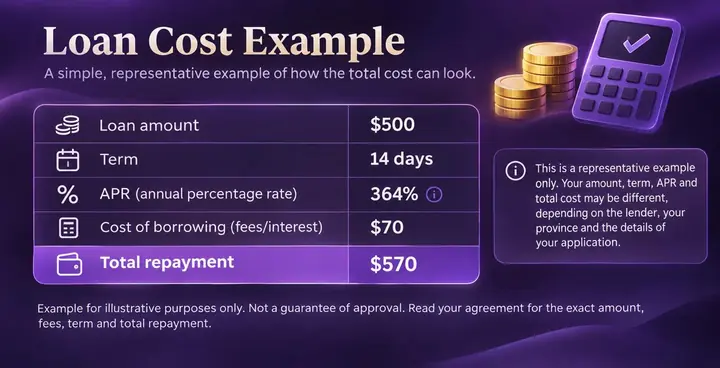
Compare the final terms, not the headline. Two lenders can pre-approve you for the same amount and charge very different totals. Look at the APR, the fees and what you’ll repay in the end.
Also ask what happens if you miss a payment. Late fees, extra interest and collection steps differ by lender, and it’s easier to read about them before you sign. If you apply to several lenders at once, remember that each application may involve its own check.
If you’re already stretched, a non-profit credit counselling agency can go through your options at no charge.
Why choose nocreditcheckloanscanada.ca
We won’t tell you that pre-approval is a promise, because it isn’t. What we will do is explain what happens at each step, what a loan costs and what can still change, so you decide with the full picture. Applications are accepted 24/7. There’s no hard pull from Equifax or TransUnion; income is checked through a secure bank connection or an uploaded statement. Loan amounts run from $100 to $50,000.
If you meet the basics and the terms fit your budget, you can start with a short form. Our no refusal instant loan page covers that product, or you can apply on nocreditcheckloanscanada.ca and read the terms before you decide.
Frequently Asked Questions
Does pre-approval guarantee I’ll get the money?
No. Pre approval is an early, conditional answer. The lender still has to verify your identity, income and bank account, and you still have to sign the agreement. Funding only happens after those steps are complete, so don’t spend the money in your head until it’s in your account.
Can pre-approval be declined at the final step?
Yes. If your documents don’t match what you entered, if your income or circumstances changed, or if the lender can’t verify something, it can reduce the amount or decline. That’s why a loan pre-approval should be treated as a first step and not a final answer. If it happens, ask the lender what didn’t check out. You may be able to fix it and apply again.

Michael Carter focuses on personal finance, alternative lending, and loan options available to Canadians with limited or poor credit histories. His articles explore no credit check loans, online lending services, and short-term financing solutions for consumers who may have difficulty qualifying for traditional bank loans.
He covers topics such as loan eligibility requirements, income verification, application procedures, repayment terms, interest rates, and borrowing costs. Michael also explains the differences between traditional credit checks, alternative approval methods, and bank account verification processes used by some online lenders.
Through his content, Michael helps readers understand how no credit check loans work, what lenders may consider when reviewing applications, and which details to examine before accepting a loan offer. He also discusses alternative financing options and practical ways to manage unexpected expenses.
Michael emphasizes transparency, financial awareness, and responsible borrowing. His goal is to make information about alternative lending easier to understand and help Canadians evaluate their financing options based on their individual financial circumstances.
More from the blog
‘Guaranteed Approval’ Loans: Why No Legitimate Lender Can Promise It
Why no legitimate lender can promise guaranteed loan approval, and what to check instead at nocreditcheckloanscanada.ca.